Flight B61230
or, why we should pause to think about SEPs.Over the weekend, Airbus recalled nearly all of its A320 fleet to patch a software update to the aircraft's Elevator Aileron Computer B (ELAC, a key component of the fly-by-wire flight control system), issued by the European Union Aviation Safety Agency.
This recall was in response to an incident that occurred over a month ago on October 30th, when JetBlue flight B61230 from Cancun to Newark experienced an unexpected pitch-down event, causing the plane to suddenly lose altitude for 4-5s a little before 18:00 UTC.
The culprit for this incident has been identified as a fault in the ELAC flight-control computer, likely due to what is referred to as an SEE, or Single Event Effect, caused by incoming atmospheric radiation. When an incoming high-energy particle interacts with the semiconductor in the ELAC, it results in data corruption and device malfunction. In the case of B61230, this caused an erroneous pitch-down -- something that echoes the MCAS system failures of the Boeing 737 MAX.
What should be stressed is the role solar flares play in the generation of atmospheric radiation. While the Airbus press office has stated that "intense solar radiation" was at play, many news outlets have been quick to claim that a strong solar "flare" was the cause.
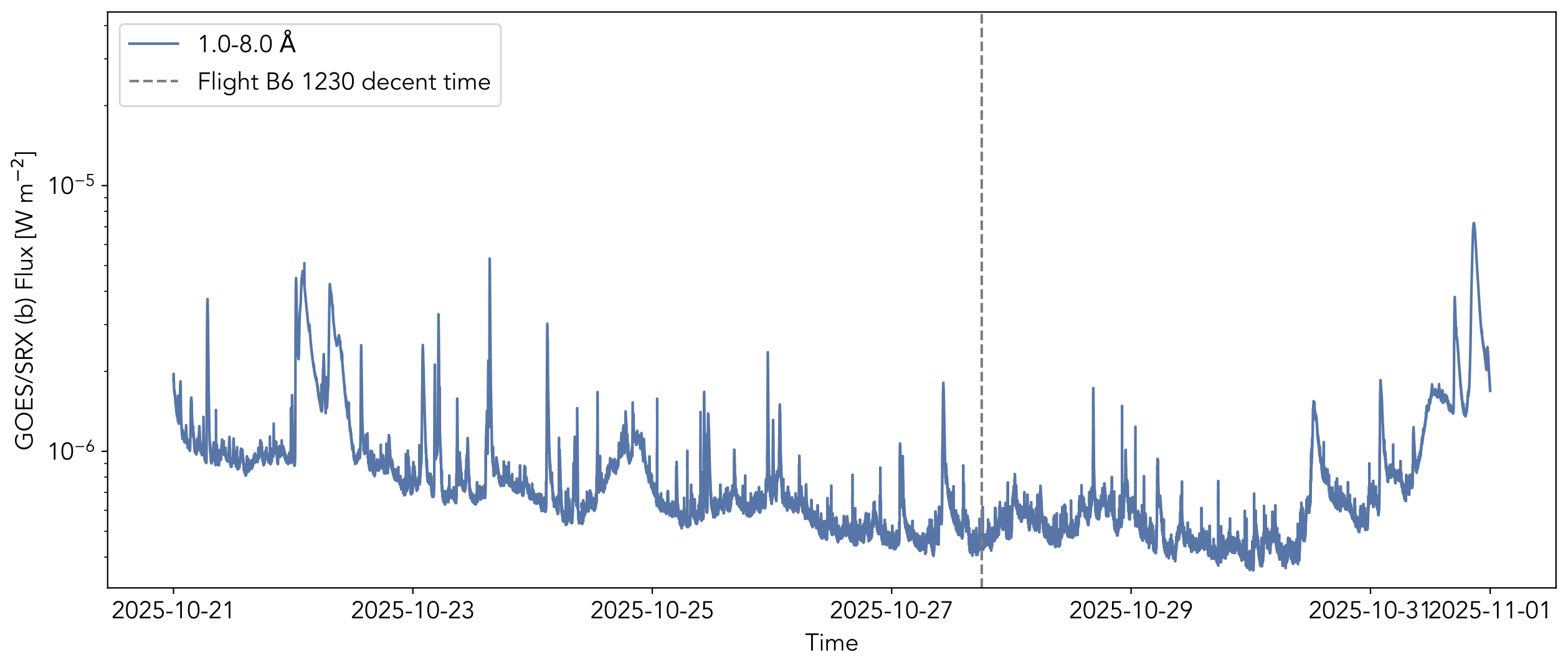
However, GOES/XRS observations show no flare occured during the flight (see figure below; the grey dashed line indicates the flight time). Even so, solar energetic particles (SEPs) are largely the result of acceleration taking place in CME shock fronts. In the days leading up to the flight, there was also very little flare activity, with the strongest flare not even reaching C2-class. It's unclear (to me, at least) whether any of the banal CMEs launched prior to this flight would have resulted in an intense increase in Earth-directed SEPs.
Galactic cosmic rays (GCRs), on the other hand, are an ever-present background of high-energy particles arriving from outside the solar system. Even at solar maximum, when the heliospheric magnetic field suppresses their flux, enough still reach flight altitudes to induce occasional single-event upsets in avionics—a well-documented hazard that requires no particular solar driver to occur. Absent a clear flare or SEP signature, a stochastic GCR-induced upset strikes me as the more parsimonious explanation.
My take: Yes, planes fly in regions of the atmosphere more susceptible to atmospheric radiation, and random isolated events (literally SEEs) can happen at any time. Was it related to solar flares? Probably not.